To be eligible to choose a project you MUST show Dr Hunt your completed part 1 wiki on Thursday.
Your project ideas must be discussed with Dr. Hunt and they must be authorised (a record will be kept).
Here are some guidelines for selecting a project. These requirements are for your own benefit, they will save you from starting something too complex for you, or too large for the time available.
Some key instructions! Important
Use full basis set 6-31G(d,p) on elements upto the 3rd row and a PP LANL2DZ on atoms beyond this
use the desktop computer for your calculations (not the server!)
if a job has not converged in 50 steps you MUST get a deomonstrator or lecturer to look at it.
for every molecule studied provide a link to the frequency file (NOT the optimisation). Provide the "summary", the "Item" table, the "low frequencies" lines and show that there are no negative frequencies.
use your data! at least 50% of the project should be centered around interpretation
time management is key, the calculations are quick, analysis is much slower
simply reporting your results will only gain you a maximum of 50% of the mark for the project
follow as similar pattern of steps from the revision material, the instructions for the mini projects are less developed, because you are now expected to know the processes and you are expected to work with more independence.
Mini project MO analysis
all of the mini-projects involve some real MO to LCAO deconstruction
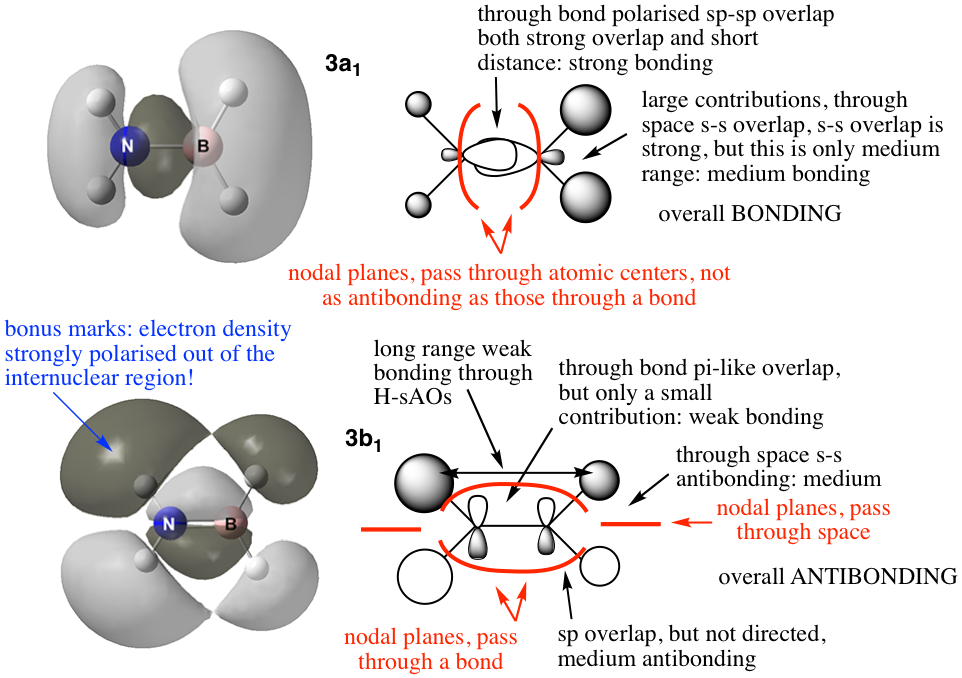
here is the kind of thing you should produce
I am looking for comments and annotations:
indicating directly bonded vs through space interactions
the distance dependence ie weak vs medium vs strong interactions
discussion of polarized or directed interactions
mention of s,p or d relative intensity of overlap
the nodal character, on atoms is less antibonding than between atoms